Melanotan II Research Guide: Melanocortin Peptide Overview
Melanotan II is a potent cyclic alpha-MSH analog spanning pigmentation, appetite, and behavioural research — this guide covers its melanocortin mechanism, evidence base, and sourcing standards.
Research Writer
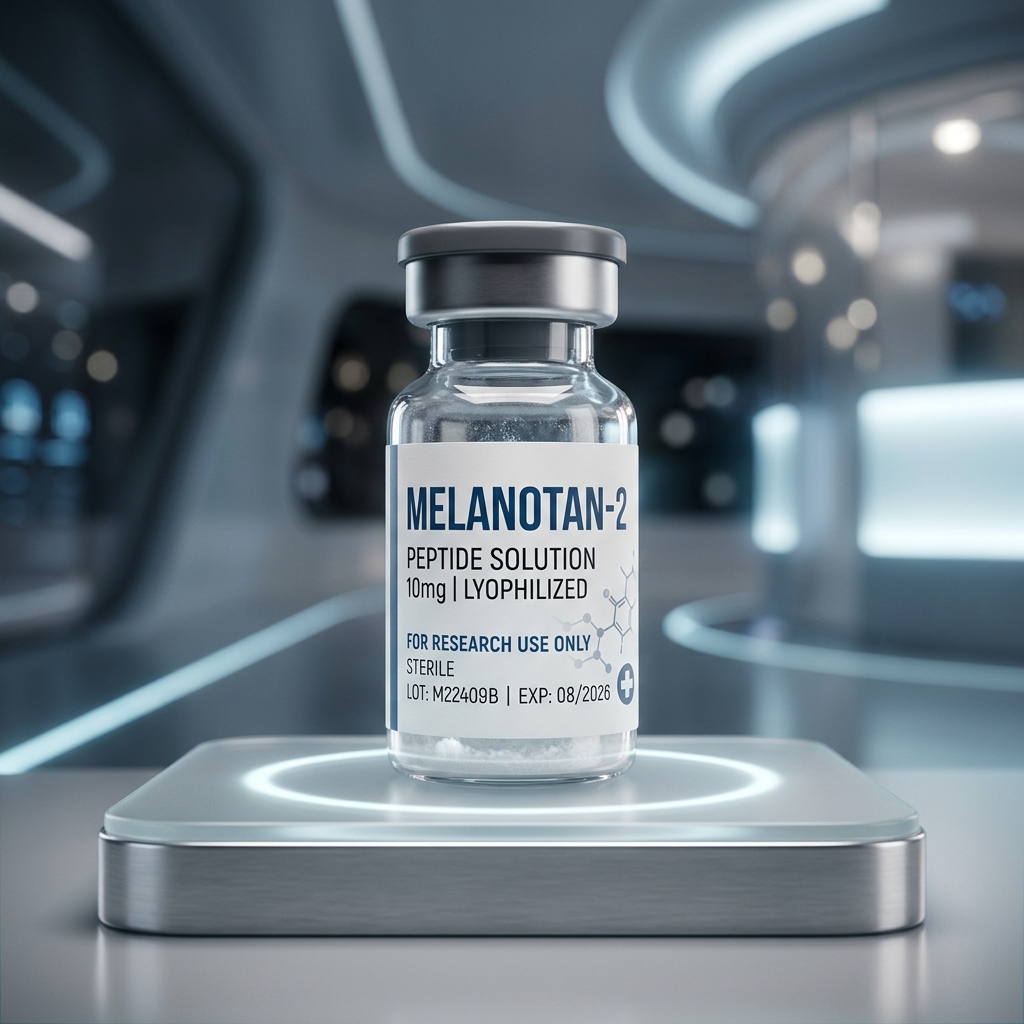
Melanotan II is a synthetic cyclic analog of alpha-melanocyte stimulating hormone (alpha-MSH) that has generated a broad and sometimes polarising research literature. Developed in the 1980s and 1990s as a candidate for tanning and arousal research, it remains one of the most potent non-selective melanocortin receptor agonists available to researchers, and it is the parent compound from which PT-141 (bremelanotide) was derived.
Structurally, Melanotan II is an alpha-MSH analog with a D-Phe substitution at position 7 and a lactam bridge that confers the cyclic conformation responsible for its potency. The mature peptide, Ac-Nle-cyclo[Asp-His-D-Phe-Arg-Trp-Lys]-OH, carries a molar mass of 1024.17 g/mol and is considerably more potent than linear alpha-MSH analogs in receptor assays, which is why measurable effects appear at low doses. It is a non-selective agonist across the melanocortin receptor family, MC1R through MC5R: MC1R drives melanogenesis, MC3R participates in energy homeostasis, MC4R mediates appetite, arousal, and central effects, and MC5R is associated with exocrine gland function. Its half-life is approximately one to two hours, and its broad receptor coverage is both its scientific utility and its main limitation.
The most extensively documented effect is UV-independent melanogenesis. By activating MC1R on melanocytes, Melanotan II stimulates eumelanin production and melanocyte dendrite elongation without requiring ultraviolet exposure, producing measurable skin darkening in study subjects. In practical terms, the effect is dose- and duration-dependent, with repeated dosing required to reach and maintain pigment changes in study models. Researchers note that this pigment is not a substitute for photoprotection, and MC1R hyperstimulation is the basis for ongoing questions about long-term melanocyte effects and melanoma risk.
A substantial body of rodent work has examined the peptide's metabolic and behavioural effects. A 2003 study in Psychopharmacology conducted in 40 rats showed that Melanotan II reduced voluntary ethanol intake by 40 to 60% and decreased high-fat food consumption, with MC4R identified as the key mediator of both effects. These findings have made the peptide a recurring tool in appetite regulation, metabolic, and addiction research, and they remain among the most cited behavioural data in the melanocortin literature.
Melanotan II is also historically significant as the source of PT-141. A 1996 study in Life Sciences first described its CNS-mediated arousal effects in an animal model of 28 rats, inducing spontaneous penile erection via central melanocortin receptors, and that observation directly seeded the development of bremelanotide. Researchers working with PT-141 should understand Melanotan II as the broader-spectrum parent compound from which the selective metabolite was derived.
Because it activates all five melanocortin receptors, Melanotan II carries a broad side-effect profile in studies: nausea and facial flushing are common, spontaneous arousal reflects MC4R activity, and darkening of pre-existing nevi and freckles follows MC1R stimulation. Its non-selectivity limits its therapeutic utility relative to selective analogs, but it remains scientifically valuable precisely because a single compound can probe multiple melanocortin pathways at once.
Published research dosages range from 0.25 to 1.0 mg subcutaneously two to three times weekly for melanogenesis studies, with lower doses around 0.1 mg used in appetite research. Researchers should also record body weight and food intake in behavioural protocols, since MC4R-mediated appetite effects can confound other endpoints. Melanotan II is not FDA-approved, and this regulatory status is an important consideration for any protocol design and for how results are reported.
Sourcing quality is decisive for melanocortin research. Vials should carry third-party HPLC and LC-MS certificates of analysis confirming purity above 99%, and the cyclic lactam structure should be confirmed by mass spectrometry, since cyclisation failures produce inactive linear species that invalidate results. Batch-to-batch consistency should be checked against the reported sequence and molecular weight, and any vial that deviates from the documented analytical profile should be treated as suspect. Lyophilized Melanotan II should be stored at -20°C, protected from light, and reconstituted only when needed. For researchers establishing a dependable supply line, Verify batch-specific Certificates of Analysis and third-party HPLC/LC-MS results before any order. Melanotan II is intended for research use only and is not approved for human use.
Melanotan II occupies an unusual position in peptide research: a potent, broad-spectrum melanocortin agonist with a long history, a clear mechanistic map, and a direct lineage to an FDA-approved drug. For researchers studying pigmentation biology, appetite circuits, or melanocortin receptor pharmacology, it remains one of the most versatile probes in the catalog.
Related compound profiles
Full compound profiles for the peptides discussed in this article.
Related guides
Continue with related research guides.
Research tools
129 compound profiles — sequences, mechanisms and cited studies.
Browse the Peptide Encyclopedia →