GHRP-2 Research Guide: Growth Hormone Releasing Peptide
A complete GHRP-2 research overview covering its potent GHSR-1a agonism, validated use in GH deficiency diagnostics, and quality considerations for research protocols.
Research Writer
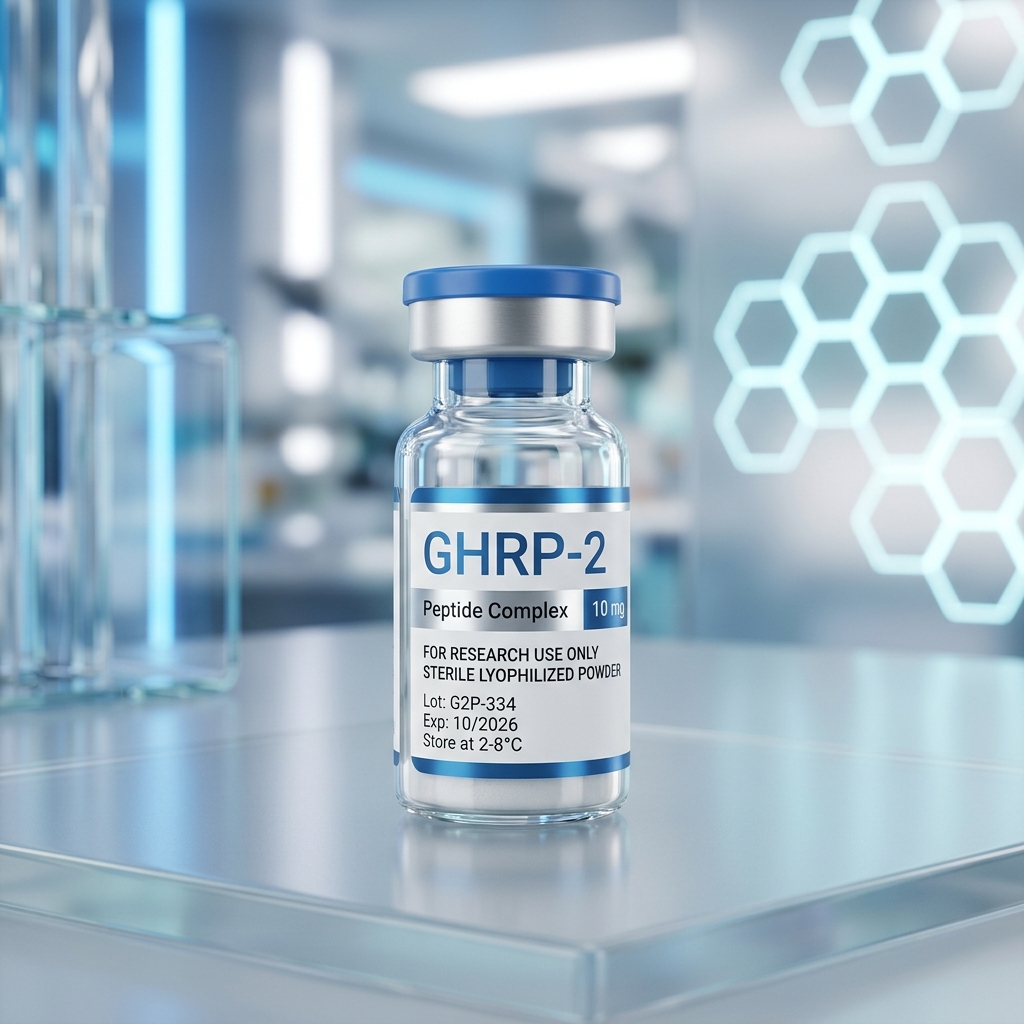
GHRP-2, also known as KP-102 or Pralmorelin, is a second-generation synthetic hexapeptide growth hormone secretagogue and one of the most studied compounds in the GHRP family, with extensive human pharmacology data accumulated over decades of research. It was developed to improve on first-generation secretagogues, and its combination of potency and a comparatively moderate side-effect profile has made it a staple of modern growth hormone axis research.
The mechanism centers on selective agonism at GHSR-1a receptors in the pituitary and hypothalamus, stimulating growth hormone release in a pulsatile manner that mirrors endogenous secretory patterns. Compared with GHRP-6, GHRP-2 shows higher GH-releasing potency and less appetite stimulation, owing to reduced ghrelin-receptor side activity. It does elevate cortisol and prolactin, but to a lesser degree than GHRP-6 or Hexarelin, positioning it in the middle of the secretagogue selectivity spectrum and making it a reasonable default choice for studies that need strong GH output without the full neuroendocrine burden of the least selective compounds.
Structurally, GHRP-2 is a hexapeptide with the sequence D-Ala-D-beta-Nal-Ala-Trp-D-Phe-Lys-NH2 and a molar mass of 817.95 g/mol. Its half-life is approximately 1 hour, and the short circulating duration shapes the repeated-dosing designs common in secretagogue research. The peptide is classified among anti-aging research compounds and remains investigational in regulatory status, despite its long history of clinical study.
A foundational 1997 study in the Journal of Clinical Endocrinology and Metabolism characterized the dose-response of GHRP-2 in healthy adults, demonstrating potent GH secretion with modest cortisol and prolactin co-elevation. At equivalent doses, GHRP-2 produced a three to five times greater GH peak than GHRP-6, with less appetite stimulation, a combination that explains its enduring popularity in research settings.
Beyond basic GH physiology, GHRP-2 has a validated diagnostic application. A 2010 study in the European Journal of Endocrinology evaluated GHRP-2 as a provocation test for adult growth hormone deficiency in 142 patients, demonstrating 92 percent sensitivity and 88 percent specificity. These figures support its use as a reliable alternative to the insulin tolerance test while avoiding the risks associated with induced hypoglycemia and providing an objective laboratory-based option for clinical research protocols.
Research applications extend to muscle protein synthesis and the broader GH-IGF-1 axis, and the peptide is frequently paired with GHRH analogs such as CJC-1295 and Tesamorelin, with which it acts synergistically by combining GHRH and GHSR-1a signaling. For researchers, GHRP-2 occupies a practical middle ground between the mild, highly selective Ipamorelin and the potent, non-selective Hexarelin, offering strong GH stimulation with intermediate cortisol and prolactin effects.
Long-term protocol design warrants additional caution. Chronic supraphysiological dosing carries theoretical risks of pituitary desensitization, IGF-1-mediated effects that merit screening in malignancy-sensitive models, and reports of joint pain and carpal tunnel symptoms in extended studies. These considerations make careful dose spacing and periodic reassessment of endpoints standard practice in GHRP-2 research designs.
Dosing in research protocols typically ranges from 100-300 micrograms subcutaneously two to three times daily, with 1 microgram per kilogram used for GH deficiency testing. Dosing frequency should be matched to the peptide's short one-hour half-life, which favors multiple daily administrations in most protocols. Best-practice guidance emphasizes administering the peptide in a fasted state for optimal GH response, spacing doses at least three hours apart to avoid receptor desensitization, and using reconstituted product within 30 days.
Quality considerations mirror those of other GHRPs. Batch-specific certificates of analysis should document HPLC purity above 99.2 percent, and mass spectrometry should confirm the exact hexapeptide sequence before the material is used in any study. Third-party LC-MS verification provides independent assurance of both identity and purity, and chromatograms should be reviewed rather than accepted at face value.
Storage is standard for lyophilized peptides: keep GHRP-2 at -20 degrees Celsius and avoid repeated freeze-thaw cycles, which can degrade the peptide and compromise assay reproducibility. Reconstitution should follow the supplier's instructions, typically with bacteriostatic water, and vials should be dated once opened.
GHRP-2 is intended for research use only and is not approved for human use, and its cortisol and prolactin effects, while modest, should be factored into any study design involving the HPA axis. For researchers seeking consistently high-purity GHRP-2 with full analytical documentation, verify batch-specific Certificates of Analysis and third-party HPLC/MS results.
Related compound profiles
Full compound profiles for the peptides discussed in this article.
Related guides
Continue with related research guides.
Research tools
129 compound profiles — sequences, mechanisms and cited studies.
Browse the Peptide Encyclopedia →