Humanin Research Guide: Mitochondrial Peptide Overview
Understand Humanin, the mitochondria-encoded peptide linked to neuroprotection, insulin sensitivity, and longevity, and why its circulating levels decline sharply with age.
Research Writer
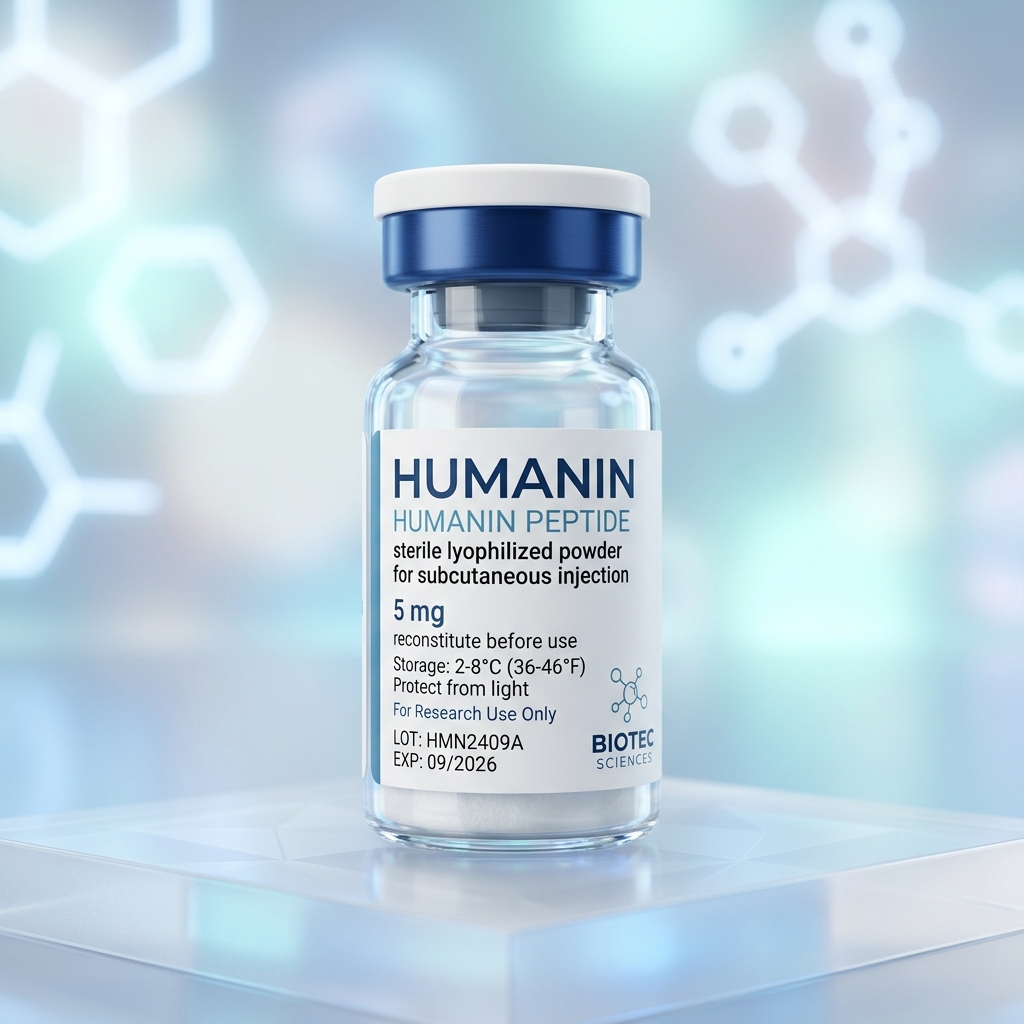
Humanin is a 21-amino-acid peptide encoded in the 16S rRNA region of the mitochondrial genome, discovered in 2001 by Nishimoto and colleagues while screening for factors that rescue neurons from Alzheimer's disease-related apoptosis. It belongs to the emerging class of mitochondrial-derived peptides, alongside MOTS-c, and represents a fundamentally different category of signaling molecule, one produced by mitochondria themselves rather than by nuclear genes. Its discovery reshaped thinking about mitochondrial DNA as a source of bioactive signaling peptides rather than purely structural components.
The peptide acts through multiple receptors, including FPRL1 and the gp130, CNTFR, and WSX-1 tripartite receptor complex, activating STAT3 and PI3K/Akt survival pathways. It inhibits BAX-mediated apoptosis, reduces mitochondrial reactive oxygen species, and improves peripheral insulin sensitivity via hypothalamic STAT3 signaling. This receptor and pathway profile underlies the cytoprotective, anti-apoptotic, and metabolic effects observed across multiple tissue types in preclinical models, including neuronal, cardiac, and reproductive tissues.
Humanin's native form has a half-life of only minutes, which is why the more stable HNG variant, carrying a Gly14 substitution, is preferred in research. The full sequence is MAPRGFSCLLLLTSEIDLPVKRRA with a molar mass of 2887.36 g/mol, and the peptide is classified among anti-aging research compounds with an investigational regulatory status and no approved indications.
The discovery paper, published in Nature Cell Biology in 2001, demonstrated that Humanin rescued neurons from amyloid-beta and mutant APP-induced apoptosis in cell cultures, establishing an entirely new class of mitochondrial-derived cytoprotective peptides. The finding that a mitochondrial gene product could protect against Alzheimer's-related cell death was a landmark result that continues to shape the field and opened the door to the systematic search for other mitochondrial-derived peptides.
A 2013 observational study in Aging Cell examined circulating Humanin levels in 362 human subjects and found they decline by 30-50 percent between ages 20 and 70, one of the steepest age-related declines documented for any peptide. Low levels independently predicted insulin resistance and metabolic syndrome, and in diabetic mice, HNG treatment improved metabolic parameters across multiple measures. The inverse correlation between Humanin and age-related metabolic decline has made it a focus of longevity research, with investigators asking whether restoring youthful peptide levels could influence the metabolic trajectory of aging organisms.
Broader research links Humanin to neuroprotection, improved insulin sensitivity, cardiovascular protection, sperm protection against apoptosis, and life extension in animal models. It is important to note, however, that no human trials exist for any indication, and much of the mechanistic work remains at the preclinical stage. Cautious interpretation of the literature is therefore essential when designing studies around this peptide.
The receptor biology is itself a notable research angle: Humanin acts through receptor complexes, including the gp130, CNTFR, and WSX-1 tripartite assembly, that are not targeted by current Alzheimer's disease therapeutics. Because STAT3 signaling sits downstream of these receptors, studies involving JAK/STAT inhibitors or pro-apoptotic cancer therapies should account for potential pathway interference when interpreting results.
Dosing in rodent models typically ranges from 2-5 milligrams per kilogram subcutaneously, and a human-equivalent dose has not been established. Because the native peptide degrades rapidly, best-practice guidance calls for using the HNG variant for improved stability in protocols and reconstituting the peptide immediately before use rather than preparing stock solutions. Investigators should also minimize the time between reconstitution and administration, since the native form's half-life is measured in minutes.
Sourcing quality is critical given Humanin's lability. Confirm purity above 98.0 percent via HPLC, verify the sequence by mass spectrometry, and request batch-specific certificates of analysis from any supplier. Third-party LC-MS testing is strongly recommended, as degraded or truncated product will not reproduce literature results, particularly in apoptosis and survival-pathway assays.
Storage requires lyophilized peptide maintained at -20 degrees Celsius, protected from light, with reconstitution performed fresh for each use. Vials should be handled under conditions that minimize moisture exposure, repeated freeze-thaw cycling should be avoided entirely, and any reconstituted material should be discarded if not used within the validated window.
Humanin is strictly a research-use compound, not approved for human use, and its extremely short native half-life and lack of human safety data demand disciplined laboratory handling. Researchers interested in mitochondrial-derived peptides should verify batch-specific Certificates of Analysis and third-party HPLC/MS results before any order.
Related compound profiles
Full compound profiles for the peptides discussed in this article.
Related guides
Continue with related research guides.
Research tools
129 compound profiles — sequences, mechanisms and cited studies.
Browse the Peptide Encyclopedia →