Hexarelin Research Guide: Growth Hormone Secretagogue
Dive into Hexarelin research, one of the most potent growth hormone secretagogues studied, with unique CD36-mediated cardioprotective properties that extend beyond GH release.
Research Writer
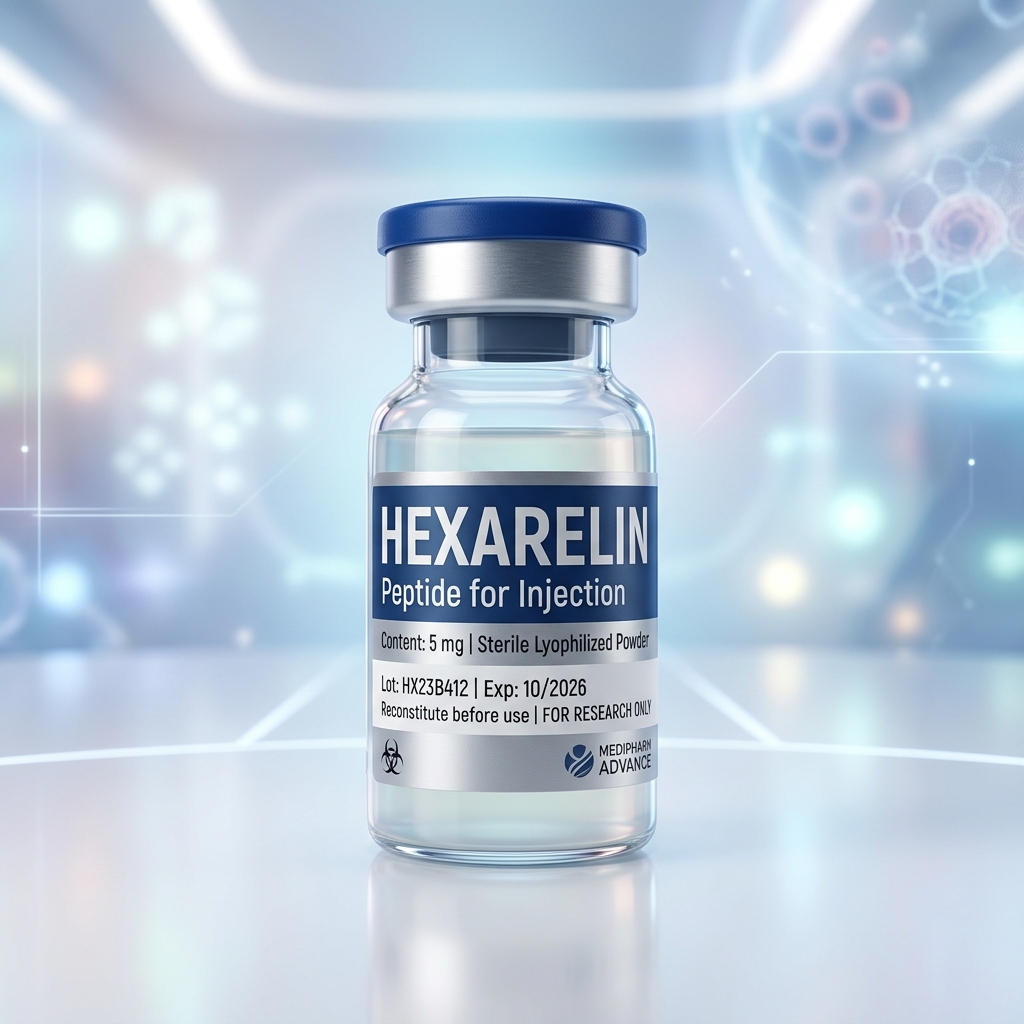
Hexarelin is a synthetic hexapeptide growth hormone secretagogue and one of the most potent GHSR-1a agonists studied to date. It belongs to the growth hormone releasing peptide family, which also includes GHRP-2 and GHRP-6, but consistently produces greater GH release than either at equivalent doses. For researchers investigating the growth hormone axis, Hexarelin represents the high-potency end of the spectrum, along with a distinctive cardioprotective mechanism that sets it apart from every other secretagogue.
The peptide's primary mechanism is potent agonism at the growth hormone secretagogue receptor GHSR-1a, which drives growth hormone release from the pituitary. Unlike the highly selective Ipamorelin, Hexarelin also activates ACTH, cortisol, and prolactin pathways, making it a non-selective tool that engages the broader neuroendocrine stress axis alongside GH. A second, entirely separate mechanism operates in cardiac tissue, where Hexarelin binds CD36 receptors and reduces ischemic damage independently of growth hormone signaling.
Structurally, Hexarelin is a six-amino-acid peptide with the sequence His-D-2-MeTrp-Ala-Trp-D-Phe-Lys-NH2 and a molar mass of 887.05 g/mol. Its half-life is approximately 1-2 hours, which is typical of the hexapeptide secretagogues and shapes the repeated-dosing designs common in GH axis protocols. The peptide is classified among anti-aging research compounds, has reached Phase 2 status in clinical development, and has been studied under the names Examorelin and GHRP-His-D2Nal in the clinical literature.
The hormonal profile was characterized directly in a 1997 randomized study published in the Journal of Clinical Endocrinology and Metabolism, which compared GH secretion after GHRP-6, GHRP-2, and Hexarelin in healthy adults. Hexarelin produced the greatest GH peak of all peptides tested, but with the highest co-elevation of cortisol, up 87 percent, and prolactin, up 245 percent, confirming it as the least selective GHSR tested in that comparison.
The cardioprotective findings are arguably Hexarelin's most distinctive contribution. A 2003 study in Endocrinology identified CD36 as a Hexarelin receptor in cardiac tissue and showed that Hexarelin reduced ischemic damage in isolated rat hearts independent of GH release, cutting infarct size by roughly 30-40 percent through a GH-independent mechanism. This dual GHS and cardiac receptor activity makes Hexarelin a genuinely unique research compound with two mechanistically separable effects.
The practical implication is straightforward: researchers choose Hexarelin when they want to study the combined GH plus cortisol plus prolactin axis, or when exploring CD36-mediated cardioprotective signaling in cardiac tissue models. For protocols requiring isolated GH evaluation without stress hormone interference, a selective secretagogue such as Ipamorelin is the more appropriate tool, and the two are frequently compared in secretagogue selectivity studies.
Researchers should also account for Hexarelin's ghrelin-receptor activity, which produces strong appetite stimulation that can be relevant in anabolic research protocols but confounds feeding and metabolic studies. Water retention and mild edema have been reported alongside the peptide's neuroendocrine effects, and chronic cortisol elevation raises concerns about pituitary receptor desensitization and glucocorticoid-sensitive endpoints in longer study designs.
Research dosing in the literature ranges from 1-3 micrograms per kilogram subcutaneously, two to three times daily, corresponding to roughly 100-300 micrograms per dose. Because of the peptide's non-selective neuroendocrine activation, protocols should account for cortisol and prolactin co-elevation when interpreting downstream endpoints such as IGF-1 or metabolic markers, and should avoid the compound entirely in models sensitive to glucocorticoid signaling.
Quality control begins with sequence verification. Hexarelin's hexapeptide sequence should be confirmed by mass spectrometry, with HPLC purity above 99.3 percent documented on a batch-specific certificate of analysis. Third-party LC-MS testing provides an additional layer of assurance that the delivered product matches the analytical claims, and researchers should request chromatograms rather than accepting summary purity figures.
Storage follows standard peptide protocol: lyophilized Hexarelin should be kept at -20 degrees Celsius, stored desiccated and protected from moisture and light, and reconstituted with bacteriostatic water only when a study protocol requires it. After reconstitution, refrigeration at 2-8 degrees Celsius with use within a validated window preserves activity for the duration of most study designs.
Like all research peptides, Hexarelin is intended for laboratory investigation only and is not approved for human use, and its cortisol and prolactin elevations make it particularly unsuited to casual experimentation. Researchers who need access to potent, well-characterized secretagogues should verify batch-specific Certificates of Analysis and third-party HPLC/MS results.
Related compound profiles
Full compound profiles for the peptides discussed in this article.
Related guides
Continue with related research guides.
Research tools
129 compound profiles — sequences, mechanisms and cited studies.
Browse the Peptide Encyclopedia →