CJC-1295 & Ipamorelin Research Guide: GHRH + GHRP Combination
Understand why CJC-1295 and ipamorelin are paired in GH axis research — the GHRH and GHRP synergy, selectivity evidence, dosing protocols, and quality checks explained.
Research Writer
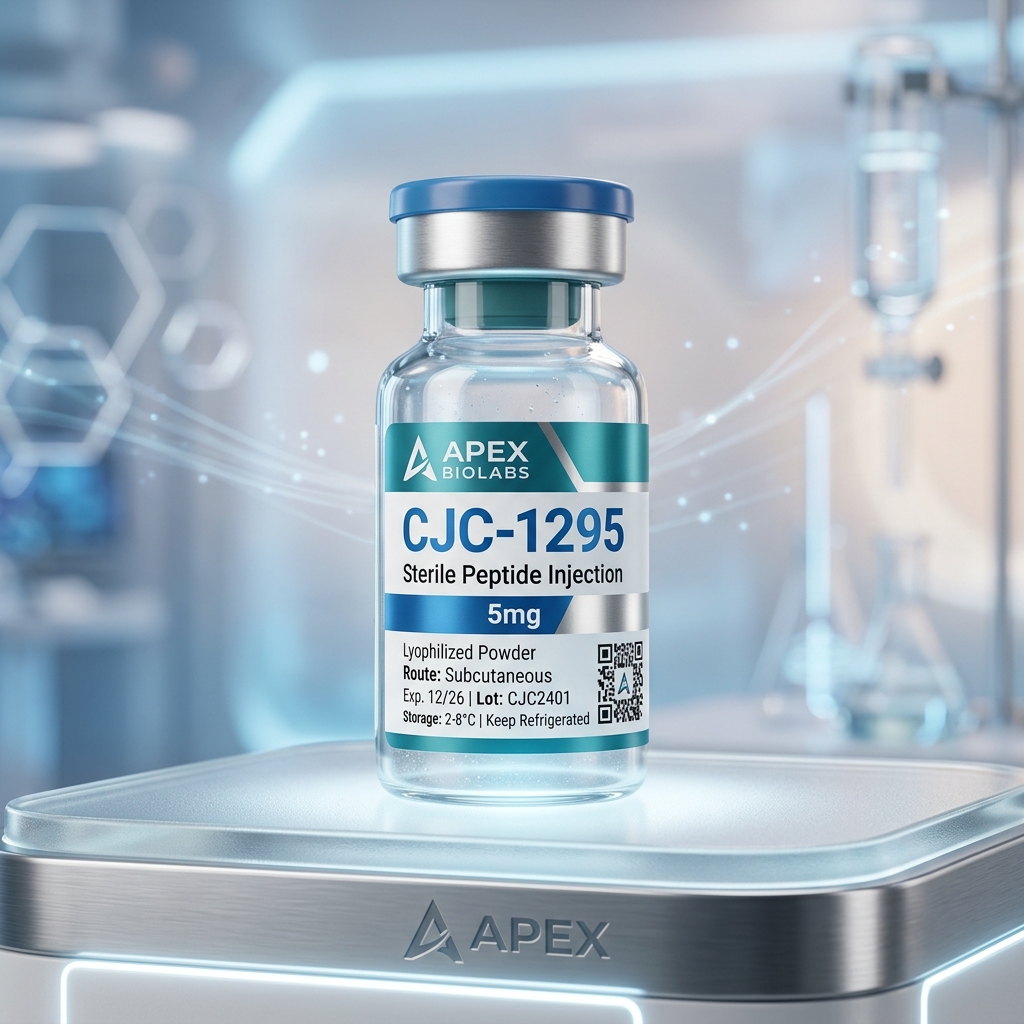
The combination of CJC-1295 and ipamorelin has become one of the most widely studied pairings in growth hormone axis research. The logic is straightforward: CJC-1295 is a growth hormone releasing hormone (GHRH) analog that amplifies the natural GH pulse signal, while ipamorelin is a growth hormone secretagogue that works through a complementary receptor pathway. Together they represent the two halves of the GHRH and GHRP strategy that dominates modern GH axis research protocols.
CJC-1295 is the GHRH(1-29) fragment carrying four key amino acid substitutions — Ala2 to Aib, Gln8 to Ala, Ser28 to Asn, and Gln29 to Ala — that improve proteolytic resistance and receptor binding. This tetrasubstituted design achieves roughly seven to ten times greater receptor binding affinity than native GHRH. It acts exclusively through GHRH receptors on pituitary somatotrophs, stimulating GH synthesis and release in a pulsatile, physiological pattern that preserves natural feedback loops rather than disrupting them. The No DAC variant carries a short half-life of approximately 30 minutes, which more closely mimics endogenous GHRH pulsatility than the modified DAC version with its week-long effects.
Ipamorelin is a pentapeptide ghrelin mimetic with the sequence Aib-His-D-2-Nal-D-Phe-Lys-NH2 that acts as a highly selective agonist of the growth hormone secretagogue receptor GHSR-1a. Its defining property is hormonal selectivity: at effective GH-releasing doses it does not significantly elevate cortisol, ACTH, aldosterone, or prolactin, unlike older GHRPs such as GHRP-2 and GHRP-6 which non-selectively activate multiple neuroendocrine pathways. This clean profile makes it a valuable research model for studying the isolated GH axis. Its half-life is approximately two hours, producing rapid, physiological GH pulses.
The rationale for combining the two is synergistic rather than additive. CJC-1295 amplifies the amplitude of the GH pulse signal through GHRHR activation, while ipamorelin contributes GHSR-1a-mediated stimulation; together they produce a larger and longer GH pulse than either compound can generate alone, an approach reflected in multiple published research protocols.
The foundational evidence for ipamorelin's selectivity comes from a landmark 1999 study in dogs and pigs published in the Journal of Endocrinology, which showed GH release equivalent to GHRP-6 with zero elevation of cortisol or ACTH. For CJC-1295, the first human pharmacokinetic study, published in the Journal of Clinical Endocrinology and Metabolism in 2006, established dose-dependent increases in GH and IGF-1, with the DAC-conjugated version elevating IGF-1 by 40 to 60% above baseline for up to six days after a single injection.
Research applications for the combination centre on age-related decline in GH and IGF-1, body composition studies, and recovery models. Because the pair preserves endogenous feedback loops rather than replacing the axis with exogenous GH, it is often favoured in protocols examining pulsatile secretion dynamics. Researchers should keep in mind that long-term GH and IGF-1 elevation carries theoretical risks, including IGF-1's role as a growth factor, and that chronic supraphysiological dosing may desensitise the pituitary.
Published protocols typically use 100 to 300 μg of CJC-1295 No DAC subcutaneously, with ipamorelin commonly combined in the 200 to 300 μg range in co-administration schemes. Because CJC-1295's half-life is short, precise timing of co-administration is important; the short half-life is precisely why the No DAC variant is preferred when a physiological pulsatile profile is the research goal.
Sourcing quality is critical for GH axis research. Both peptides should arrive with third-party HPLC and LC-MS certificates of analysis confirming purity above 99%, and sequence verification of ipamorelin's pentapeptide is essential given its small size. Reputable suppliers provide batch-specific documentation, and researchers should verify that the reported purity matches the vial label for every lot received.
Storage follows standard lyophilized peptide practice: -20°C until reconstitution, with CJC-1295 reconstituted immediately before use given its limited stability in solution. When establishing a supply chain for combination protocols, many researchers choose vendors offering verified documentation and global logistics — Choose vendors offering verified documentation and global logistics — batch-specific Certificates of Analysis and cold-chain shipping. Both peptides are intended for research use only and are not approved for human use.
The CJC-1295 and ipamorelin pairing remains a cornerstone of GH axis research because it addresses the two limiting steps of endogenous GH release simultaneously. For researchers studying pulsatile secretion, age-related hormonal decline, or the interplay of GHRH and ghrelin pathways, the combination offers a mechanistically coherent model with a substantial supporting literature.
Related compound profiles
Full compound profiles for the peptides discussed in this article.
Related guides
Continue with related research guides.
Research tools
129 compound profiles — sequences, mechanisms and cited studies.
Browse the Peptide Encyclopedia →