DSIP Research Guide: Delta Sleep-Inducing Peptide
DSIP targets slow-wave sleep, stress buffering, and pain pathways through a unique modulatory mechanism — this guide covers its pharmacology, mixed clinical evidence, and handling basics.
Research Writer
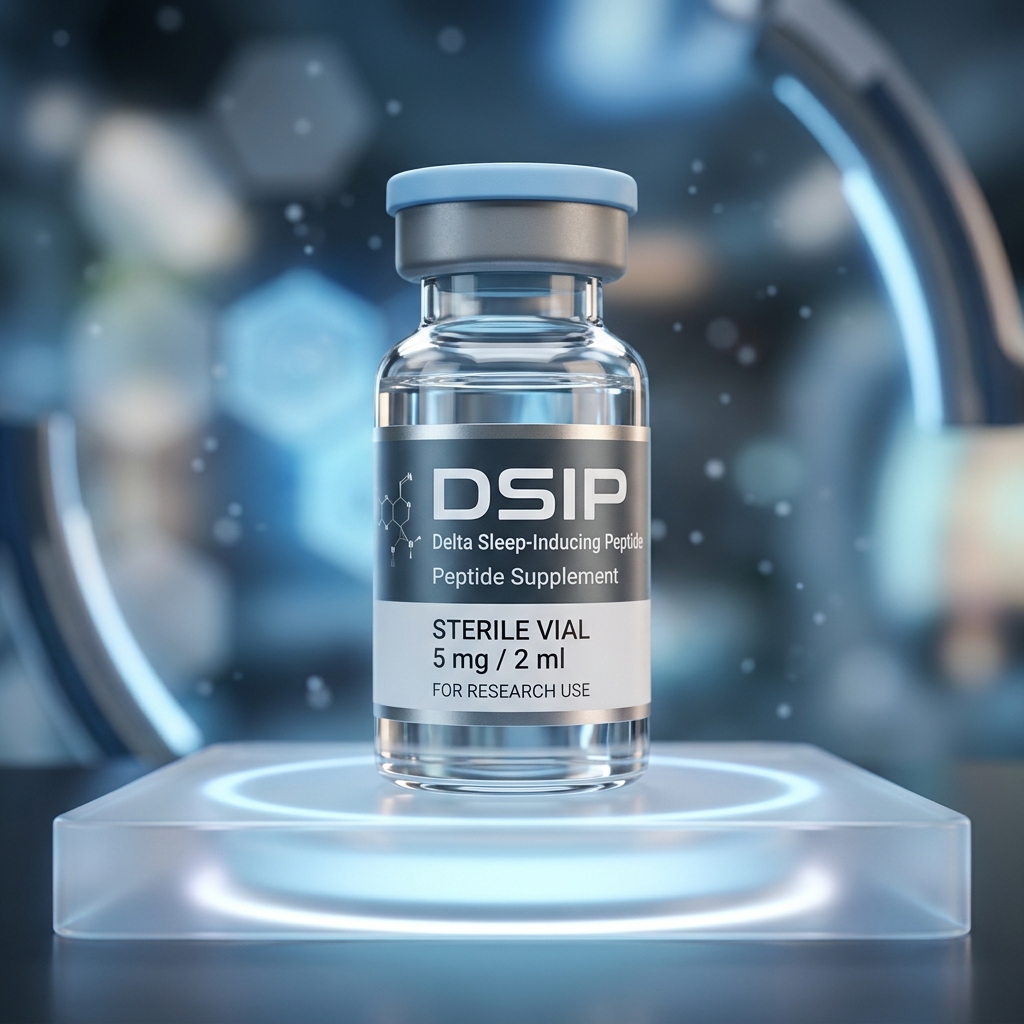
Delta sleep-inducing peptide, or DSIP, occupies a unique place in neuropeptide research as the first peptide identified through a physiological sleep screen. It was isolated in 1974 from the cerebral venous blood of rabbits induced into slow-wave sleep by electrical stimulation of the thalamus, and it has since accumulated decades of European research spanning sleep, stress, and pain biology. DSIP is a nonapeptide with the sequence Trp-Ala-Gly-Gly-Asp-Ala-Ser-Gly-Glu, notable among neuropeptides for its ability to cross the blood-brain barrier, a property that allows systemically administered peptide to reach central targets and shapes virtually every protocol design decision.
DSIP's mechanism is best described as modulatory rather than sedative. It influences the sleep-wake cycle through thalamic and limbic pathways, buffers the HPA axis stress response without suppressing baseline cortisol, interacts partially with opioid receptors for analgesic effects, and reduces lipid peroxidation as an antioxidant. Its plasma half-life is measured in minutes, yet its CNS activity persists considerably longer, a dissociation that has shaped how researchers design dosing schedules around the peptide's central effects rather than its circulating levels.
The original characterisation work, published in Experientia in 1977 with a sample of 24 rabbits and cats, demonstrated that DSIP infusion induced delta-wave EEG patterns within minutes, establishing the first evidence for an endogenous sleep peptide. Unlike sedative compounds that force unconsciousness, DSIP appears to promote natural slow-wave deep sleep while preserving normal sleep architecture, which is why it remains a recurring subject in sleep-stage and sleep-quality research rather than a simple hypnotic.
The stress literature is arguably DSIP's most distinctive contribution. A 1984 review in the journal Peptides summarised its amphoteric HPA modulation: DSIP reduces stress-induced cortisol spikes while leaving baseline cortisol untouched. This amphoteric behaviour — buffering the amplitude of the stress response while leaving its set point intact — is unusual among HPA-modulating compounds and has made DSIP a tool of interest for researchers studying stress physiology without the confounding suppression produced by glucocorticoid antagonists.
Analgesic research has examined DSIP's interaction with opioid pathways. Studies attribute pain-modulating effects to partial opioid receptor engagement, and the combination of stress buffering and analgesia has drawn interest from researchers working at the interface of pain and sleep disturbance. In animal models these effects have been reported across multiple species, though translation to human pain studies remains preliminary. Its antioxidant activity, mediated through reduced lipid peroxidation, adds a further dimension to a multi-functional profile that spans several physiological systems.
It is important to note the limits of the evidence. Human sleep studies have produced mixed results, with a meaningful proportion of non-responders, and the short plasma half-life constrains utility in some designs. Researchers should plan protocols with individual response assessment in mind rather than assuming uniform effects across subjects, and response screening with a low initial dose before committing to a full protocol is a common design strategy.
Published research protocols use 100 to 300 μg subcutaneously before bedtime, with many researchers beginning at 50 to 100 μg to assess individual response, and the short plasma half-life means that timing relative to sleep onset matters more than total dose. A distinctive practical detail is the reconstitution vehicle: DSIP should be reconstituted with saline rather than bacteriostatic water, because the benzyl alcohol preservative may reduce its potency.
Quality verification follows the usual analytical path: third-party HPLC and LC-MS certificates of analysis, with purity above 98.5% considered acceptable for this peptide given its sensitivity profile. The sequence should be confirmed by mass spectrometry, and the lyophilized product should be stored at -20°C and protected from light, as DSIP is known to be light-sensitive.
For researchers sourcing DSIP across borders, documented batches and dependable logistics are essential — Verify batch-specific Certificates of Analysis and third-party HPLC/MS results. DSIP is an investigational compound intended for research use only and is not approved for human use.
DSIP remains one of the more intriguing neuropeptides in the research catalog precisely because its effects are subtle, modulatory, and multi-system. Its long research history, dating to the 1970s, gives investigators an unusually deep literature to anchor new hypotheses. For researchers investigating slow-wave sleep, HPA axis stress buffering, or the intersection of sleep and pain, it offers a well-documented peptide with a distinctive pharmacology that no sedative can replicate.
Related compound profiles
Full compound profiles for the peptides discussed in this article.
Related guides
Continue with related research guides.
Research tools
129 compound profiles — sequences, mechanisms and cited studies.
Browse the Peptide Encyclopedia →